

Fire Door Lock Compliance Guide for Raleigh Buildings

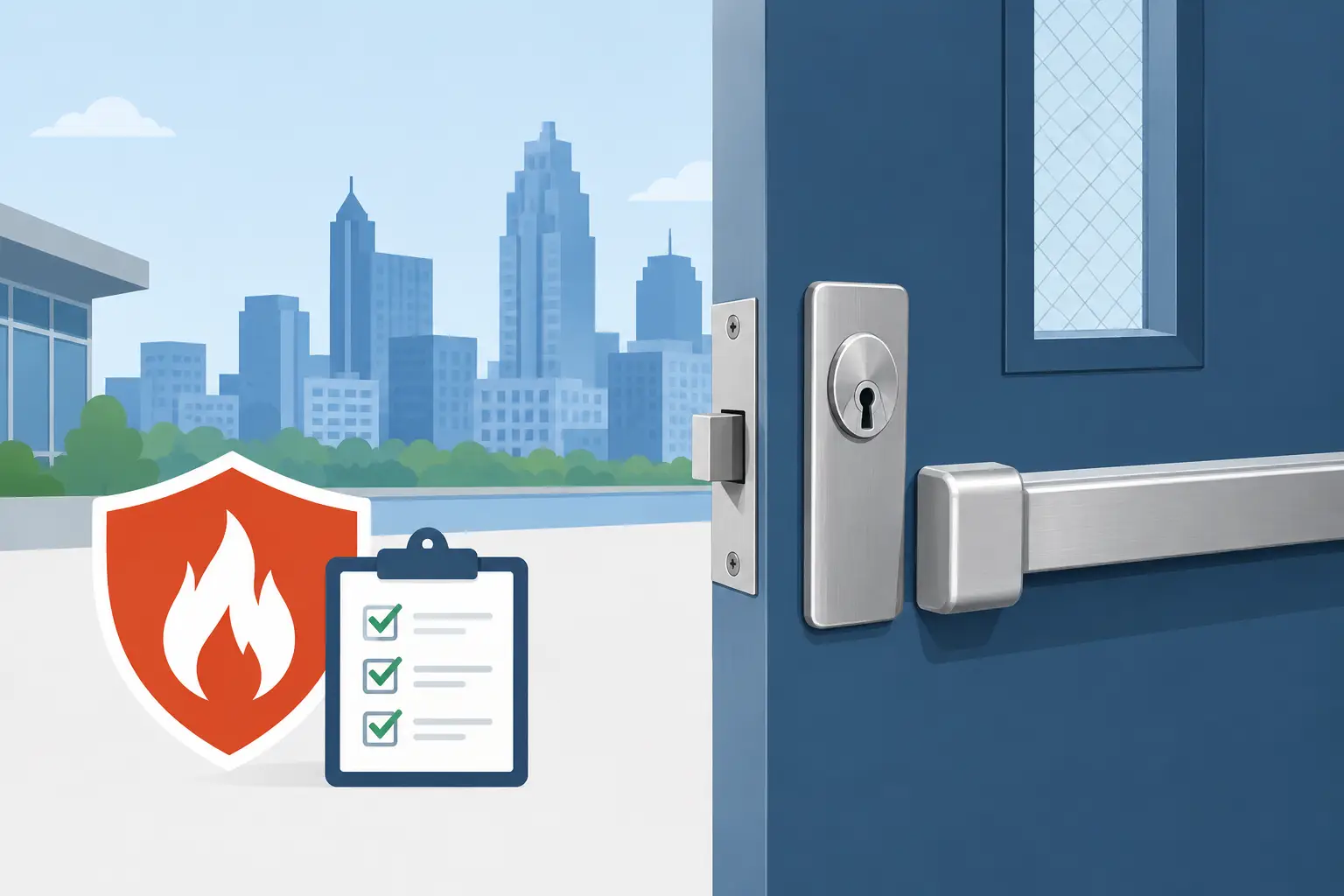
A fire door that will not latch is more than a maintenance problem. It can allow smoke and fire to spread through a hallway, stairwell, or tenant space far faster than intended. This fire door lock compliance guide helps Raleigh-area building owners, managers, and business operators understand what to look for before a routine inspection, renovation, or urgent repair.
Fire door compliance is not about installing the strongest lock available. It is about keeping a rated door assembly capable of closing, latching, and allowing people to exit safely when it matters most. The door, frame, hinges, closer, latch, strike, hardware, and any access control components must work together.
What makes a fire door lock compliant?
A fire door is part of a tested and labeled assembly. Its job is to slow the movement of fire and smoke between areas of a building for a specified period. The lock hardware cannot interfere with that purpose or prevent safe egress.
For most swinging fire doors, positive latching is a central requirement. When the door closes, the latch bolt needs to engage the strike so the door remains secured in its frame during a fire. A latch that barely catches, sticks, or fails to engage may cause the opening to fail an inspection.
At the same time, occupants must be able to exit without needing a key, special knowledge, or unusual effort. The exact requirements depend on the occupancy type, door location, fire rating, adopted code, and direction of travel. A back-room door in a retail business may have different hardware needs than a stairwell door in a multi-story office building.
That is why fire door work should never be treated as a standard lock change. Replacing a lever, adding a deadbolt, or connecting an electronic lock without checking the complete assembly can create a life-safety issue.
Fire door lock compliance guide: the rules that matter most
Local enforcement is handled by the Authority Having Jurisdiction, often referred to as the AHJ. In Raleigh and surrounding North Carolina communities, that may include the local fire marshal, building official, or another code enforcement authority. They determine how applicable state and local requirements apply to your property.
While the final decision rests with the AHJ, several practical rules apply in many commercial settings.
The door must self-close and fully latch
A fire door is not protecting the opening if it is held open, blocked by furniture, or unable to overcome air pressure and close completely. The closer should bring the door from its open position to the frame, and the latch should engage the strike without someone pulling or pushing the door into place.
A common problem is a misaligned strike caused by sagging hinges, loose screws, building movement, or a damaged frame. Another is a closer adjusted too weakly to latch. The repair may be simple, but the result must be verified with the door operating normally.
Hardware must be fire-rated for the opening
Fire-rated doors generally require listed or labeled hardware compatible with the door’s rating. Removing original hardware and filling holes, drilling new holes, or installing an unlisted lock can compromise the door and its label.
This does not mean every lock on every fire door is identical. Mortise locks, cylindrical locks, rim devices, exit devices, and electrified hardware may all be appropriate in the right application. What matters is whether the hardware is suitable for that specific rated opening and preserves the door assembly’s performance.
If you cannot locate the fire label on the door or frame, do not assume the door is non-rated. Paint, repairs, or prior alterations can obscure labels. Have a qualified professional evaluate the opening before making major changes.
Egress cannot be blocked by added security
Extra security is often the source of compliance trouble. A keyed deadbolt, slide bolt, chain, surface latch, or aftermarket barricade device may seem like an easy answer to break-ins, but it can prevent rapid exit or interfere with a fire-rated door’s operation.
On doors required to provide egress, occupants generally need to be able to open the door from the egress side without a key or separate releasing action. In many higher-occupancy locations, panic hardware or fire exit hardware may be required. These devices are designed to release with a single pushing motion and, where required, remain suitable for a fire-rated opening.
Security and code compliance can coexist. The correct solution may be a properly specified exit device, a controlled-access system, a door position switch, or an access credential system that releases as required during an emergency. It depends on the building use and door location.
Electrified locks need a life-safety plan
Card readers, keypads, maglocks, electric strikes, and delayed-egress systems can improve control over who enters a building. They also introduce more compliance considerations than a mechanical lock.
A fire door with electronic access control must still allow the required exit path. Depending on the system and application, this can involve fire alarm integration, loss-of-power release, emergency release hardware, appropriate signage, and code-approved wiring and controls. Magnetic locks and delayed-egress devices are particularly sensitive because their use is not appropriate for every door or occupancy.
Do not rely on a locksmith alone to guess at system behavior during a fire alarm or power outage. Complex access-control changes may require coordination among a locksmith, electrician, fire alarm contractor, security integrator, and the AHJ.
Problems inspectors commonly find
Many fire door deficiencies are visible during a basic walkthrough. Building staff can catch issues early by checking that doors close and latch after normal use, rather than waiting for an annual inspection or a fire marshal visit.
Watch for these recurring problems:
- A door is propped open with a wedge, trash can, hook, or furniture.
- The latch bolt does not enter the strike or the door must be slammed to latch.
- A closer is leaking, disconnected, improperly adjusted, or missing.
- Added locks, chains, or surface hardware interfere with egress or door closing.
- The door or frame has unapproved holes, damaged edges, missing labels, or field modifications.
Do not overlook the gap around the door, damaged smoke seals, loose hinges, or items stored in the swing path. A compliant lock cannot compensate for a door that is warped, obstructed, or unable to close into its frame.
When a repair becomes a compliance decision
A tenant may report that a lever is loose, a key will not turn, or an employee was locked out of a stockroom. Those sound like ordinary locksmith calls, but the answer changes when the door is fire-rated.
Before replacing hardware, identify the door’s location and purpose. Is it a stairwell door, a corridor door, an electrical room, a rear exit, or a door separating tenant spaces? Is it part of a required exit route? Does it have a visible label? Does it use panic hardware or electronic access control?
For a simple repair, the right approach may be to restore the existing listed hardware and correct alignment. For an upgrade, such as a keypad or keycard reader, the project may require a more complete review. The trade-off is clear: adding security can reduce unauthorized entry, but the wrong hardware can create an egress hazard and lead to costly corrections later.
A practical maintenance routine for property managers
Fire door inspections are often required at regular intervals under applicable fire-door standards and local enforcement practices. Your property’s specific inspection obligations should be confirmed with the AHJ or a qualified fire-door inspection provider.
Between formal inspections, assign a staff member to report doors that fail to close, latch, or release properly. Keep maintenance records, especially after hardware repairs or access-control changes. If a door is temporarily out of service, address it promptly and follow your building’s safety procedures rather than leaving it propped open or altered.
For multi-tenant buildings, communicate clearly with tenants. Employees sometimes add a padlock, wedge, or aftermarket latch for convenience without realizing it affects life safety. A short reminder can prevent a serious issue.
Get the right help before changing fire door hardware
Fire doors require careful work because a small change can affect both security and life safety. If a fire-rated door will not latch, has damaged lock hardware, or needs an access-control upgrade, start with an assessment of the full opening rather than a quick hardware swap.
Advance Locksmith Inc can help Raleigh-area businesses address lock and door hardware concerns with practical, professional service. For electronic systems or changes that affect fire alarm operation and egress, the safest path is coordinated work with the appropriate licensed trades and local authority.
A door that closes, latches, and lets people exit as intended is one of the quietest protections in your building. Give it attention before the next inspection, not after a preventable failure.